Partners: Casey Law, Nikita Kosogorov, Tanazza Khanam, Tom Morrell
SSEC Engineers: Don Setiawan, Cordero Core, Ishika Johari
Research Goals and Domain
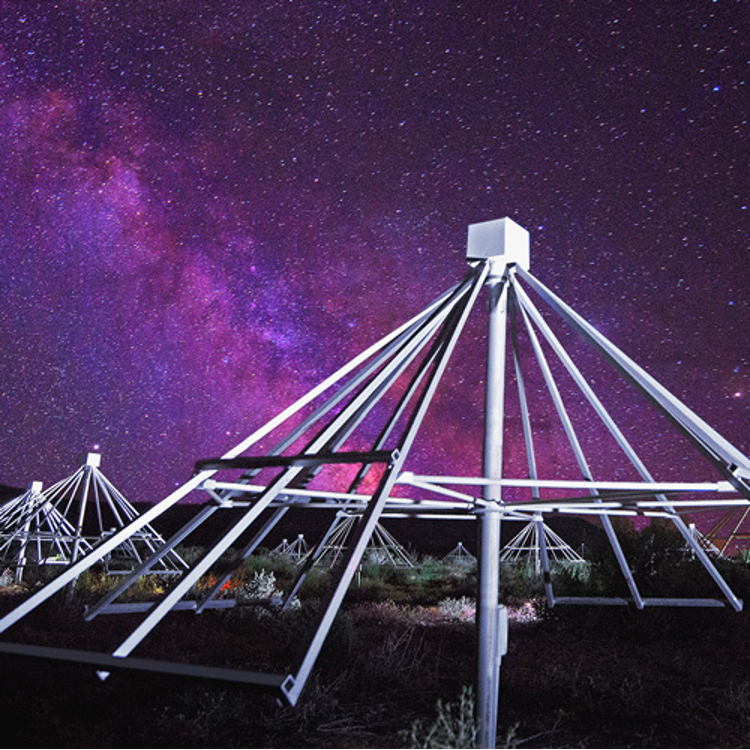
The Owens Valley Radio Observatory, Long Wavelength Array (OVRO-LWA) is a low-frequency (15–85 MHz) all-sky radio telescope designed to detect and study phenomena such as auroral emissions from exoplanets, gravitational wave counterparts, cosmic-ray air showers, and the 21-cm signal from the early universe. The resulting database encompassing 96 TB of images collected by the telescope needs software engineering to create performant tools to transform, access, view, and analyze the telescope data.
Software Problem
The existing standard for accessing OVRO-LWA data relies on traditional SSH-based methods that are cumbersome, slow, and inaccessible to many researchers. These workflows lack interactivity, scalability, and ease of use, making it difficult for scientists to perform common tasks such as dynamic spectrum extraction, quality filtering, and visualization. Additionally, the absence of a unified interface and efficient data access mechanisms limits the usability of the dataset and impedes collaboration across institutions.
Software Solution
SSEC is bringing cross disciplinary best practices by streamlining the FITS-Zarr conversion via a Python-based utility library that leverages the Scientific Python Community Pandata stack. This library will also enable interactive access to the OVRO-LWA data stored in Zarr format on S3-compatible cloud storage on the CaltechDATA platform from Caltech Libraries. The backend will leverage the xarray and dask library for efficient server-side data slicing and selection, minimizing client-side computation. SSEC and eScience are home to several regular contributors to the xarray library who will bring their extensive experience to this implementation. Additionally, front-end will support dynamic spectrum plots, interactive sky image displays, and publication-ready visualizations using the Panel library within Jupyter Notebooks. Authentication is handled via S3 credentials with read-only access for initial deployment. The end-to-end architecture is modular, scalable, and compliant with FAIR principles, ensuring maintainability and future extensibility. For the software engineering, SSEC is piloting a modern agentic AI approach with specialized sub-agents to assist with code generation, review, and evaluation, offering context-aware support.
Impact
The platform aims to deliver a tenfold improvement in analysis speed compared to SSH workflows, with sub-second response times for basic queries and efficient handling of multi-dimensional data. It will support dozens of concurrent users and enable astronomers with varying technical skills to access and analyze large-scale datasets. The system facilitates reproducible research through metadata preservation, version control, and standardized data export formats. By streamlining access to these data, the platform hopes to accelerate scientific discoveries and lay the groundwork for similar adoption across the DSA-2000 communities.