-
Data Science Meets the Humanities and Social Sciences: Notes from the Summer Institute
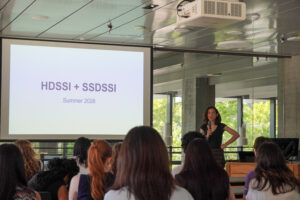
With support from the eScience Institute and the UW Data Science Minor, the Humanities Data Science Summer Institute (HDSSI) entered its fourth year with a new twist. This summer, the program’s humanities research teams joined forces with social science researchers to expand the institute’s reach across campus. Now, HDSSI exists alongside the Social Science Data…
-
Responsible GenAI for NASA Earth Science Datasets
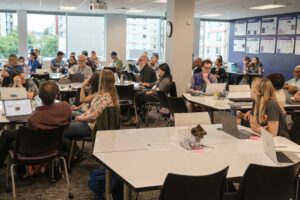
What can Generative AI do for scientists working with NASA Earth Science datasets? This is the question members of the NASA Earth Science community sought to answer at the eScience Institute’s latest hackweek Responsible GenAI for NASA Earth Data 2026. Through a series of tutorials and project brainstorming, participants explored how GenAI could help researchers…
-
Development of a custom acoustic classifier to detect the Micronesian megapode, a rare bird

Project Lead: Kaeli Swift, UW School of Environmental and Forest Sciences Data Science Leads: Spencer Wood and Vaughn Iverson The Commonwealth of the Mariana Islands (CNMI) is a small archipelago located in the Western Pacific. Like other island systems, the Marianas are home to several endemic and rare species, including the Micronesian megapode (Megapodius laperouse…
-
eScience Launches AI in Practice Summer Institute

This summer, sixty people gathered at the University of Washington in Seattle to engage in a 5-day training in AI methods for research, facilitated project work, and self-directed learning. The first AI in Practice Summer Institute, sponsored by the eScience Institute, offered a unique educational experience for researchers that went beyond a general overview of…
-
National Data Platform Receives NSF Category I Award to Expand AI-Ready Data Infrastructure for U.S.

The U.S. National Science Foundation (NSF) has awarded the National Data Platform (NDP) a five-year, $24.5 million Cooperative Agreement to build a federated, AI-ready national data ecosystem, making it easier to discover, access and analyze data – regardless of where it is stored. Under the new award, the University of California San Diego will lead development of…
-
NeuroHackademy Celebrates 10 Years

This summer, 90 attendees gathered from universities across the world to take part in NeuroHackademy on its 10th anniversary. With support from the eScience Institute and the National Institute of Mental Health, this 2-week workshop, hosted at the University of Washington in Seattle, taught participants about technologies used to analyze neuroscience data and how to…
-
LLMoxie: Informed AI Workflows for Researchers

Partners: eScience Institute, National AI Research Resource (NAIRR) Pilot Program, Schmidt Sciences (Virtual Institute for Scientific Software), Microsoft Azure, AWS, Hugging Face; CloudBank SSEC Engineers: Landung (Don) Setiawan, Anant Mittal, Cordero Core, Niki Burggraff, Anshul Tambay, Carlos Garcia Jurado Suarez, David A. C. Beck, Andrew J. Connolly, Sarah Stone, and Vani Mandava Background Working within the eScience Institute, SSEC’s…
-
Advancing Data Utility in the Washington Integrated Surveillance for Antimicrobial Resistance Database (WISAR)

Project Leads: Hannah Fenelon, Peter Rabinowitz, Erica Fuhrmeister, Clare Burbick, and Vickie Ramirez, Center for One Health Research Data Science Lead: Curtis Atkisson Washington Integrated Surveillance for Antimicrobial Resistance Database (WISAR) contains over one million isolates with antimicrobial susceptibility results. These isolates are from samples from humans, animals, and the environment throughout Washington and in…
-
A novel regression framework for Southern Ocean surface carbon reconstruction using merged observations from ships and autonomous floats
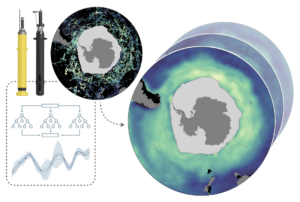
Project Lead: Sangmin Song, Oceanography Data Science Lead: Scott Henderson The ocean holds a massive 93% of the world’s carbon that cycles among the atmosphere, land, and sea. Because of its capacity to absorb vast amounts of human-emitted carbon from the atmosphere each year, the ocean has effectively buffered society’s impact on climate over the…
-
Investigating Seasonal Glacier Fluctuations in Northeast Greenland Using Machine Learning and Explainable Artificial Intelligence

Project Lead: Claire Jensen, UW Earth and Space Sciences Data Science Lead: Scott Henderson The Greenland Ice Sheet (GrIS) is losing mass due, in part, to the recent speedup of many of the outlet glaciers that line the ice sheet. Mass loss from outlet glaciers can be characterized by (1) retreat of the glacier’s frontal…