
-
A Roadmap to Assessing Community Engagement at UW
By Kate Rich From interning with local nonprofit organizations to monitoring the marine economy, research, teaching, and learning at the University of Washington regularly involve community engagement work. The Building Tri-Campus Capacity for Community Engagement initiative’s Priority Work Team defines community engagement at UW as “the collaboration between the University (students, faculty, staff, and alumni)…
-
Using Computer Vision to Understand Collective Navigation in Salmon
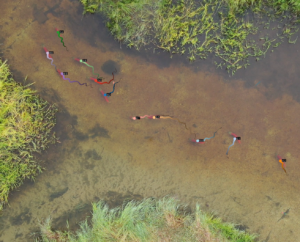
Project Lead: Andrew Berdahl, UW School of Aquatic and Fishery Sciences and Ben Koger, University of Wyoming School of Computing and Department of Zoology and Physiology Data Science Lead: Valentina Staneva From daily foraging movements to long-distance migrations, animals often travel in groups, and their navigational decisions are influenced by those around them. Theory suggests that…
-
Open IRE: Increasing Access to Published Research

Partners: Elizabeth Bedford, Richard Boyechko, Jose Cols SSEC Engineers: Niki Burggraf, Vedant Somani Background University of Washington Libraries is creating an automated workflow to collect publications from UW researchers to centralize and preserve their work and make it openly available to the world in UW’s institutional repository, ResearchWorks. Research is published across a wide range…
-
A new approach to understanding homelessness in King County
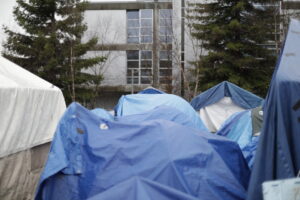
To better understand the needs of the growing houseless population in their communities, local governments need to know how many unhoused people there are in the first place. For nearly two decades the United States Department of Housing and Urban Development required local jurisdictions to attempt a biennial census of unhoused people on a single…
-
UW Partners with University of Helsinki for Outdoor Recreation and Tourism Research

Park and protected area management across the world relies on a robust understanding of how to balance conservation with recreation and tourism that supports people’s quality of life. As global leaders on computational research in this area, the Outdoor Recreation and Data Lab at the University of Washington (UW) and the Digital Geography Lab at…
-
Enhancing LSTM streamflow modeling in data-scarce rain-dominated basins: the impact of using multiple precipitation products as model inputs
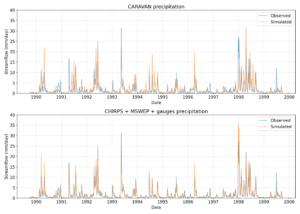
Project Lead: Hernán Querbes Duhart Data Science Leads: Nicoleta Cristea and Scott Henderson GitHub Repo Uruguay relies heavily on hydropower, with three dams along the Río Negro providing nearly half of the country’s electricity. Accurate streamflow modeling is therefore critical for dam operations and energy reliability. Machine learning, particularly Long Short-Term Memory (LSTM) networks, has…
-
On testing hearing sensitivity across the animal kingdom more quickly and accurately
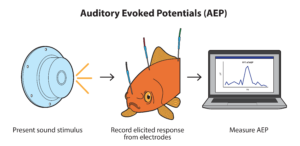
Project Lead: Aoi Hunsaker, Andrew Brown and Joseph Sisneros, UW Psychology Data Science Lead: Ariel Rokem I study what sounds animals can hear by recording brain responses while I play sounds over a speaker. This kind of test is called the Auditory Evoked Potential (AEP) test. There is a need in my field to do these recordings…
-
HuskyFetch API

Project Leads: Jason Civjan, Zahra Taher, Adelin Ma, and Maeve Seyer, UW IT Data Science Lead: Curtis Atkisson UW-IT’s Student Innovation Lab (SIL) is dedicated to helping UW students from all disciplines explore solutions to problems facing the UW community. We provide access to UW data, resources, and consultations to support fast, effective, and responsible…
-
Longitudinal Uptake Patterns in Patients with Grade 1-2 Well-Differentiated Gastroenteropancreatic Neuroendocrine Tumor on Long-Acting Somatostatin Analogs
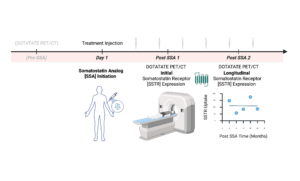
Project Lead: Ai Phuong S. Tong, UW Medicine Data Science Lead: Curtis Atkisson Our project explored how a specialized imaging technique called somatostatin receptor (SSTR) positron emission tomography (PET) changes over time in patients with neuroendocrine tumors, a type of slow-growing cancer that often affects the gastrointestinal system. These scans help doctors visualize tumors by…
-
Retinal Circuit Model for Color Vision
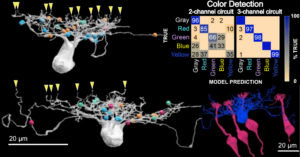
Project Leads: Kathryn Tabor and Jay Neitz, UW Medicine Data Science Lead: Noah Benson You pick a ripe, red strawberry outside in the bright sunshine, and shortly thereafter the same fruit still appears the same shade of red in the dimly-lit kitchen, even though the spectrum of light reaching the eye has changed dramatically. Color…