
-
Affective state analysis of ultrasonic vocalizations in animal models of mTBI/PTSD and neuropathic pain
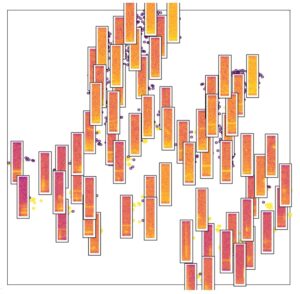
Project Lead: Abigail G. Schindler, acting assistant professor, Psychiatry and Behavioral Services eScience Liaison: Valentina Staneva Chronic health conditions (e.g. mental health, pain) are increasing in the US and contribute substantially to decreased quality of life, loss of productivity, and increased financial burden. Indeed, the CDC estimates that over 90% of annual health care expenditures…
-
Predicting human-mediated vectors for invasive species from mobile technology
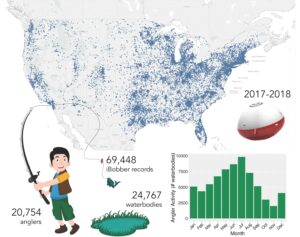
Project Lead: Julian Olden with Rachael Fricke, both UW School of Aquatic and Fishery Sciences eScience Liaison: Spencer Wood Invasive species pose a significant threat to ecosystem health and economies of nations across the globe. Freshwater recreational fishing is the largest and growing vector for invader introductions: specifically, because angler activities entangle invasive organisms on…
-
A network analysis of tree competition: Which tree species make the best neighbors?
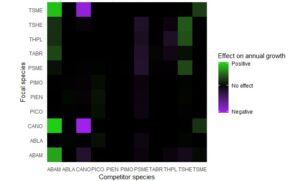
Project Lead: Stuart Ian Graham, UW Biology Department eScience Liaison: Ariel Rokem A quantitative understanding of how co-occurring tree species influence one another’s growth is required to predict how forest ecosystems will respond to climate change. Although competition with neighboring trees undoubtedly limits tree growth, the species identity of neighbors may have an important role…
-
Beneficial competition under rationing: evidence from food delivery service
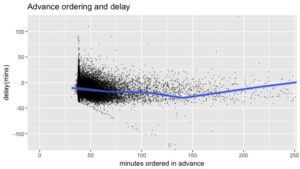
Project Lead: Kwong-Yu Wong, UW Department of Economics eScience Liaison: Jose Hernandez Rationing is usually necessitated whenever some external constraints causing quantity of goods provided in lack of what is required (e.g. essential supplies in wartime, surgery needed, meals during peak hours etc.). In Economics literature, rationing is commonly regarded as welfare reducing because it easily…
-
Atmospheric particulate matter source identification using excitation emission fluorescence spectroscopy
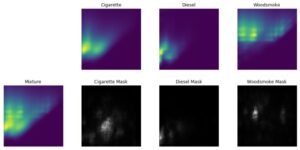
Project Lead: Jay Rutherford, UW Department of Chemical Engineering PhD Candidate eScience Liaison: Bernease Herman Air pollution is estimated to cause 4.9 million premature deaths and result in 149 million disability adjusted life years annually.(1) 91% of the world’s population lives with air pollution levels above the World Health Organization Guidelines.(2) These facts make it the world’s largest…
-
Team receives Earth science funding
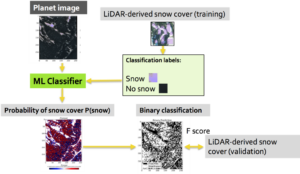
May 7, 2019 A team of University of Washington (UW) researchers led by eScience research scientist Nicoleta Cristea has received Lab Incubator Project funding from Earth Science Information Partners (ESIP). The project is titled “Developing workflows for assessing high-resolution CubeSat imagery to infer detailed snow-covered areas for studying changes in ecosystems and water supply.” The funding will help…
-
Deep Learning Institute held at eScience
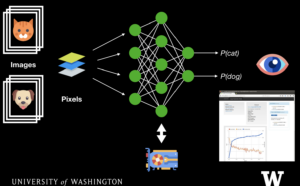
February 28, 2019 On Feb. 22 the UW Research Computing team hosted a Deep Learning Institute (DLI) on using machine learning for computer vision at the eScience Institute. The DLI was attended by a diverse set of participants ranging from students at the undergraduate level through full professors from departments within engineering, business, and medicine.…
-
Team receives NIH grant for Alzheimer’s disease research

February 27, 2019 Senior data science fellow Su-In Lee and collaborator Matt Kaeberlein have received a grant of just over $3 million from the National Institutes of Health for their project “Interpretable machine learning to identify Alzheimer’s disease therapeutic targets.” In the United States alone, someone receives an Alzheimer’s diagnosis every 66 seconds, and the disease has become…
-
Press release: Results from the UW Evictions Project
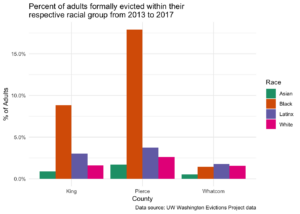
February 21, 2019 A team of University of Washington researchers including eScience postdoctoral fellow Timothy A. Thomas, Ott Toomet, Ian Kennedy, and Alex Ramiller, has released a report titled “The state of evictions: results from the University of Washington Evictions Project” as a living website that will be frequently updated with their work: https://evictions.study. Washington…
-
eScience executive leadership changes

February 7, 2019 Micaela Parker, eScience co-executive director with Sarah Stone, will be transitioning to a new position beginning the week of Feb. 11, 2019. Over the past year, she has been holding two joint appointments: as the eScience co-executive director and as the program coordinator for the Moore-Sloan Data Science Environments (MSDSE) where she has…