What can Generative AI do for scientists working with NASA Earth Science datasets? This is the question members of the NASA Earth Science community sought to answer at the eScience Institute’s latest hackweek Responsible GenAI for NASA Earth Data 2026. Through a series of tutorials and project brainstorming, participants explored how GenAI could help researchers search and discover NASA Earth Science datasets using plain language prompts. Whereas navigating data portals can be time-consuming and challenging, GenAI has the potential to accelerate discovery and expedite the process of data wrangling. Moreover, GenAI coding agents can help researchers build open source software more efficiently and robustly. Looking to the future, many researchers hope that GenAI may assist in identifying patterns and connections within and between datasets that can help incite scientific breakthroughs.
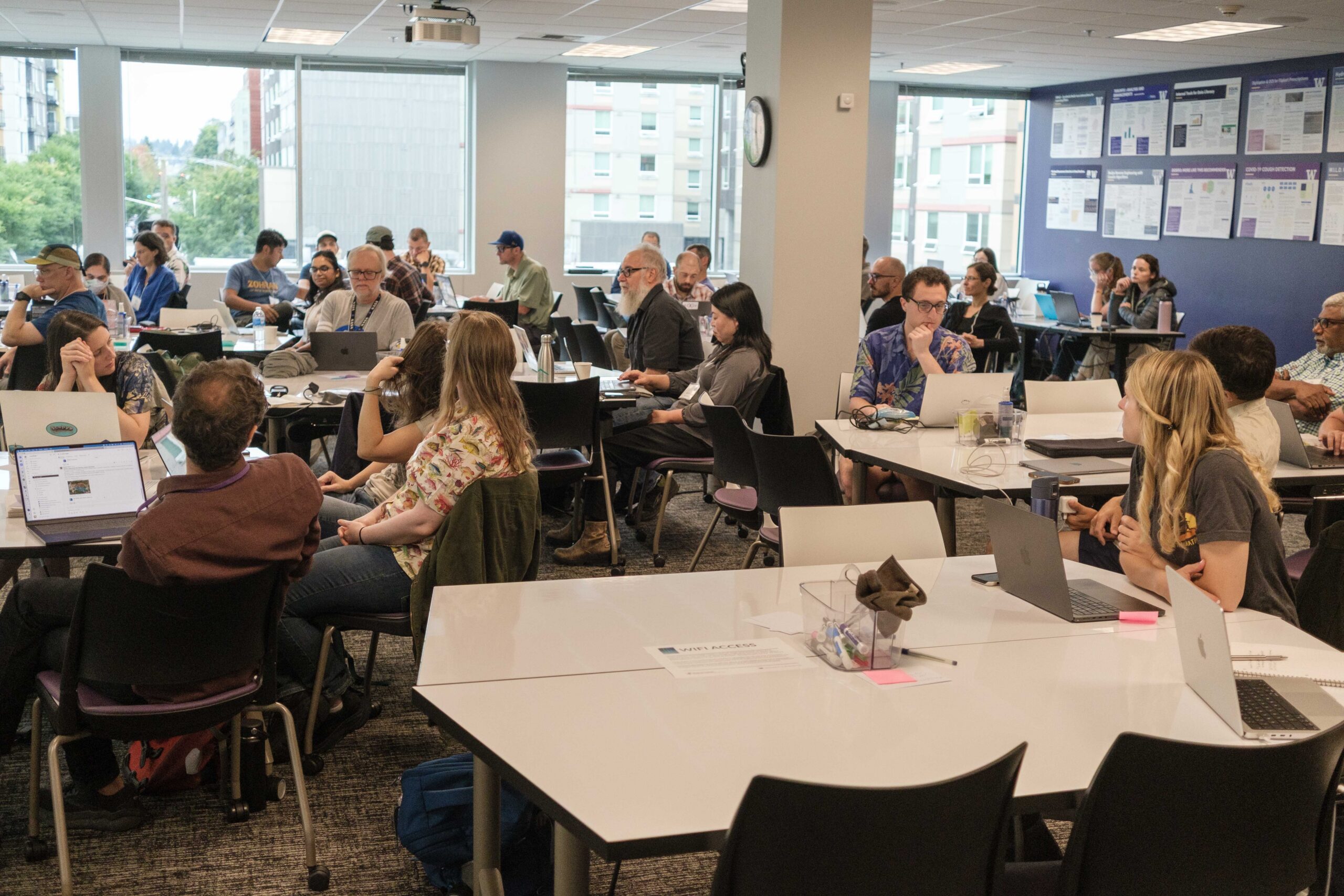
The hackweek participants were nearly 50 developers from a variety of universities, companies, government agencies, and nonprofits, all of whom were already working on GenAI for NASA Earth Science data and looking to establish best practices. NASA’s Earth data assets primarily consist of data collected from remote sensing platforms such as satellite and airborne sensors. For instance, datasets discussed during the hackweek include satellite laser altimetry measurements from the IceSat-2 mission and synthetic aperture radar data from the newly launched NISAR mission. These data are used for a range of applications such as assessing the impact of glacier changes amid rising global sea levels, tracking global climate variations, and predicting the impacts of natural hazards on communities.
In an effort to establish community guidelines for using GenAI with these data, hackweek attendees engaged with a comprehensive set of tutorials beginning with an introductory session that laid out the current state of generative AI tools. Here, the instructors and participants prioritized the development of a shared vocabulary and a common mental model of how generative AI can help achieve research goals, with a focus on ensuring their work is reproducible, robust and secure. Then, the attendees learned about some of the key mechanisms by which scientists can provide context and set up guardrails to ensure that coding agents provide assistance in ways that can be carefully tracked by humans.
The instructors also explained some of the emerging protocols for connecting generative AI agents to toolkits and external data sets. With the emergence of generative AI coding agents, developers require tailored infrastructure to provide their research teams, including those who do not have LLM accounts, with access to the appropriate tools. The University of Washington Scientific Software Engineering Center (SSEC) stepped up to fill this gap with their LLMoxie (will link to project page) AI Gateway. The SSEC team co-led tutorials and wired LLMoxie into the hackweek’s existing JupyterHub so that attendees could follow along with tutorials and carry out project work with a frictionless harness and without having to pay for access to LLMs.
Guest speakers from beyond the University of Washington contributed to the curriculum as well when software engineers from the Allen Institute for AI shared a tutorial about their recent work on purpose-built agents that allow for expert-curated experiences. Specifically, they demonstrated their Skylight product, a maritime domain awareness tool used in an operational context to reduce illegal fishing practices. This was of great interest to those at the hackweek as they pondered developing similar tools for applying NASA Earth data to specific stakeholder challenges among Earth scientists. Additional guest speakers joined the event from Element84, Development Seed, and Earthmover that have a history of deep engagement with previous eScience hackweek programs. These teams shared their experience using GenAI to solve a variety of earth science challenges using NASA datasets.
Other tutorials examined the best practices for setting up larger scale workflows when working with a coding agent. The group also discussed ways to validate results and ensure security when working with GenAI tools for science. This conversation included questions about what a more responsible GenAI might entail. The instructors led a group activity where they invited everyone to consider where GenAI research opportunities might land on a risk vs. reward diagram. This spurred many reflections not only on the benefits of AI but also on its potential negative impacts. When the group identified high risk scenarios, they followed up with a discussion on strong governance strategies that could monitor and help mitigate those risks. For example, some AI tools can easily produce believable looking output for a full science workflow with NASA Earth Science data. However, there is a higher risk that the results are not scientifically valid if a domain expert is not checking the output along the way. In the face of these troubling possibilities, the hackweek curriculum regularly emphasized the necessity of expert human guidance at every stage of the workflow.
The week concluded with plans for future projects including a white paper, to be sent to NASA headquarters, with a set of recommendations for community-wide best practices and suggestions for future governance strategies. Several of the project teams will continue pursuing other ideas started at the event such as creating agents for specific NASA satellite missions. Looking forward, the lessons learned from this hackweek will be used to offer mentorship to the next Openscapes Champions cohort and potentially other educational opportunities. The organizers hope to continue collaborating with those who developed tutorials to turn their content into a comprehensive set of training modules for future programs.
