
Project Lead: Aoi Hunsaker, Andrew Brown and Joseph Sisneros, UW Psychology
Data Science Lead: Ariel Rokem
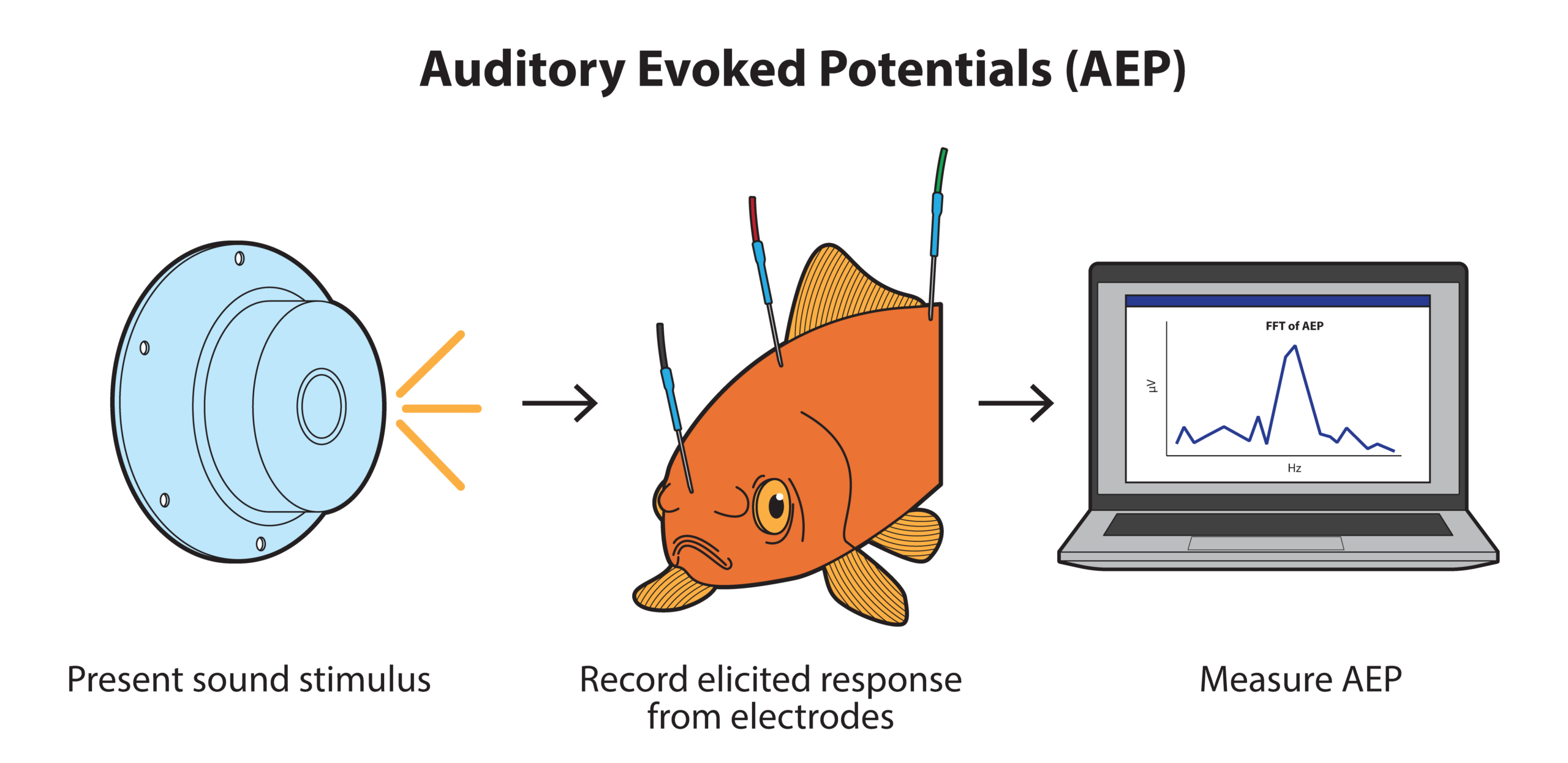
I study what sounds animals can hear by recording brain responses while I play sounds over a speaker. This kind of test is called the Auditory Evoked Potential (AEP) test. There is a need in my field to do these recordings more quickly and accurately. Currently, AEP tests take over an hour to complete for a single subject. Thus, for animals that are sensitive to experimental handling, comprehensive auditory testing is not currently possible. Furthermore, the sensitivity of an animal’s hearing is commonly determined by an experimenter visually inspecting the brain response waveforms. This method of response detection is subjective and can possibly lead to inaccurate estimations of auditory sensitivity. In the AI and Data Science Accelerator Program, I worked with Dr. Ariel Rokem to develop a software tool that implements an automated response detection algorithm and model-based auditory threshold estimation during testing. The response detection algorithm involves comparing bootstrapped distributions of auditory response strengths when the sound is ON vs. OFF. Threshold estimation involves fitting the lower half of a hard-sigmoid to auditory response strength data plotted against stimulus intensity and defining the threshold as the elbow point in the model. Throughout my participation in the AI and Data Science Accelerator program, I learned in greater detail about useful statistical methods such as bootstrapping and model fitting. Furthermore, I learned good practices in writing software such as writing tests and modularizing code.