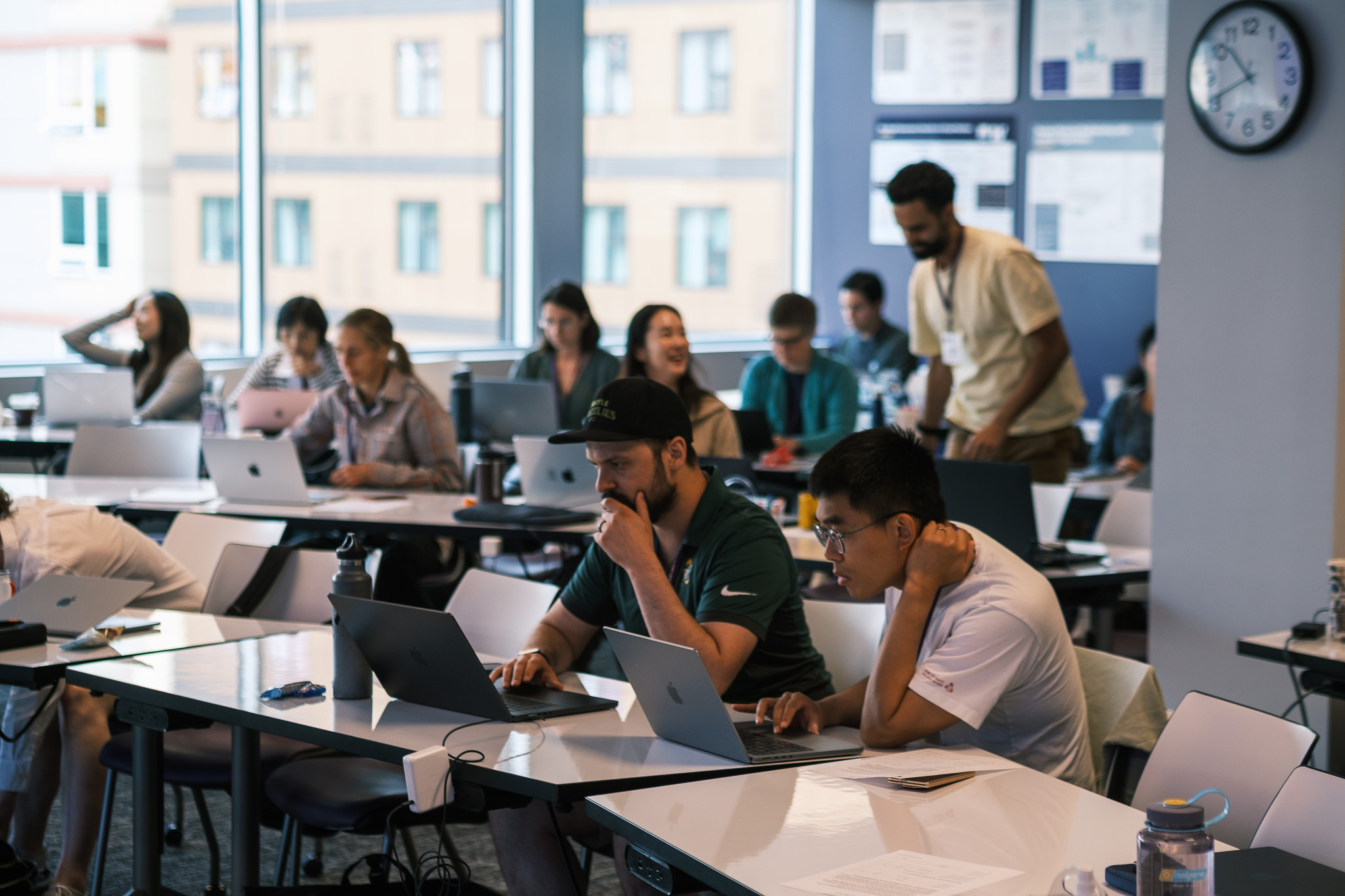
This summer, sixty people gathered at the University of Washington in Seattle to engage in a 5-day training in AI methods for research, facilitated project work, and self-directed learning. The first AI in Practice Summer Institute, sponsored by the eScience Institute, offered a unique educational experience for researchers that went beyond a general overview of AI concepts and applications. Despite an abundance of online artificial intelligence tutorials, researchers require more specific direction to navigate the right content for their use case and apply it to their work. Through a variety of tutorials and project consulting opportunities, the institute offered a distinct focus on real-world AI applications in research. Participants from all three UW campuses arrived with a research project of their choosing to explore AI methodologies and had a team of instructors provide guidance at each step of the way.
The institute began with a Foundations Day to provide an introduction to neural network training and evaluation. The rest of the week centered around the AI research lifecycle. A team of instructors and helpers from across the University of Washington guided attendees from problem formulation and model selection, to training and evaluation, and finally to interpreting and sharing results. At each stage of the lifecycle they received instruction on how to consider what it means to use AI responsibly, as well as how to identify and mitigate risks. Put another way, they identified critical stages in the AI development process where human judgment and expertise are essential.
The participants’ projects were at different points in the AI research lifecycle. Some had a potential AI model in mind and had to learn how to apply it, while others needed to brainstorm with instructors on how to select models suitable for the challenge their data presented. Participants in the early stages of their projects focused on designing strategies for data organization and machine learning experiment setup in addition to scoping ideas for future proposals. For those eager to integrate agentic automation in their workflows, the UW Scientific Software Engineering Center (SSEC) provided free access to Claude LLMs via their AI Gateway LLMoxie. Since developing AI models often relies on having access to computational infrastructure, representatives from CloudBank and UW-IT Research Computing also shared resources available to researchers to access high-end GPUs, store large datasets, and scale workflows.
The institute mainly took place in the new Master of Data Science program space, but the participants were treated to a brief field trip to Ai2 headquarters during Seattle Tech Week to learn how large open-source AI models such as OLMo are built and evaluated. After five days of intensive project work and tailored tutorials, the summer institute ended with a project-sharing poster session. From research in power grid systems to Asian languages and digital arts, participants were able to share their AI-powered projects across disciplines and reflect on potential steps for the future of their research.
