
Project Leads: Zhuoshi Li, Dorothy Reed, and, Partha Sarkar, UW Civil & Environmental Engineering and Iowa State University of Science and Technology Aerospace Engineering
Data Science Lead: Nicoleta Cristea
Tornadoes are the most violent of all atmospheric windstorms. Although they occur throughout the world, the highest frequency is observed in the US, where over 1,700 tornadoes were recorded in 2024 alone. Intensity measures that characterize tornado damage, such as the Enhanced Fujita (EF) scale, are derived from post-event assessment on the ground. This somewhat circular aspect of damage characterization and EF scale determination remains a major limitation for long-term prediction of damage.
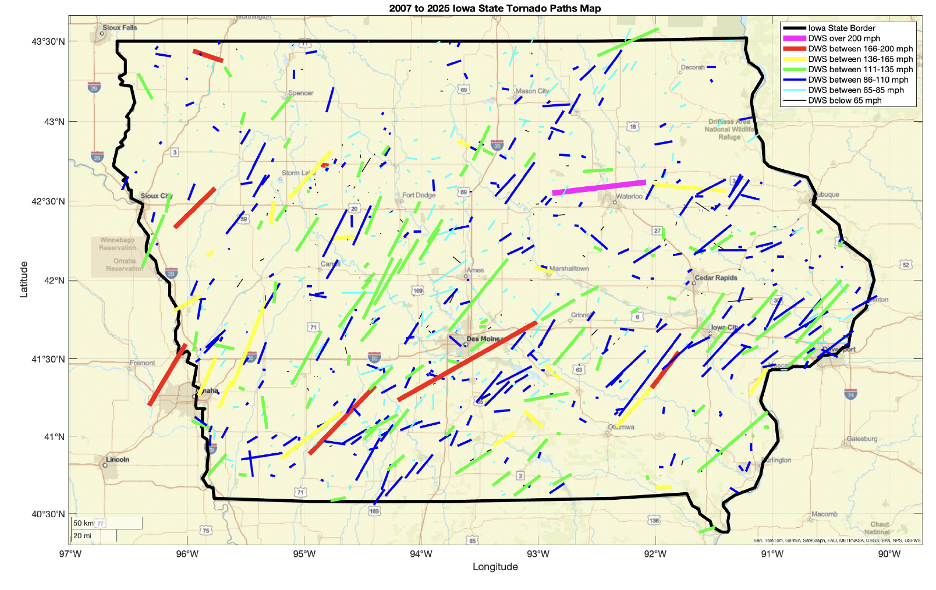
Recognizing the inherent limitations of the standard EF scale, an engineering-relevant hazard characterization is proposed based on a data-driven machine learning framework to predict the probability that a tornado’s maximum damage wind speed will exceed specific thresholds within the EF3 range (136–165 mph). We first quality controls and cross-validates records from three primary federal datasets: the Storm Events Database, the Damage Assessment Toolkit, and the Storm Prediction Center database, yielding a curated historical dataset of over 630 authenticated EF3–EF5 tornado events in the United States from 2007 to 2025. We then used a Random Forest classification framework to predict tornado maximum damage wind speed exceedance from four geometric features of the tornado path— track length, maximum width, and the sine and cosine components of path bearing. We used State-specific tornadoes held out from model development to further evaluate our models generalizations. The framework was centered on the data from the State of Iowa and subsequently tested across various geographical States and regions to examine spatial transferability. The results identify path width as the most influential predictor of severe tornado intensity among the predictors examined, while differences in predictive performance among States indicate that State-specific models may better capture States variability than a universal cross-State model.