
Project Lead: Kwame Donkor, UW Electrical and Computer Engineering
Data Scientists: Curtis Atkisson and Piotr Gorski
Climate change is making extreme weather more frequent and severe, putting new stress on electricity grids. In Sub-Saharan Africa, where grids must also support expanding electrification and renewable energy, this pressure is especially acute. Most outages that customers experience originate on the distribution network, the final layer of the electric power grid that delivers power to homes and businesses. Restoring power quickly is key dimension of power grid resilience, and it depends on utilities knowing exactly where it is out. However, given how vast it is, the distribution grid has few sensors, so outages in many neighborhoods go unseen until customers report them. Deep learning models could help fill these gaps by inferring conditions at unmonitored locations from monitored ones, but distribution-level data in the sub-region is generally scarce in two main ways: temporally (few historical outage records) and spatially (few locations are instrumented).
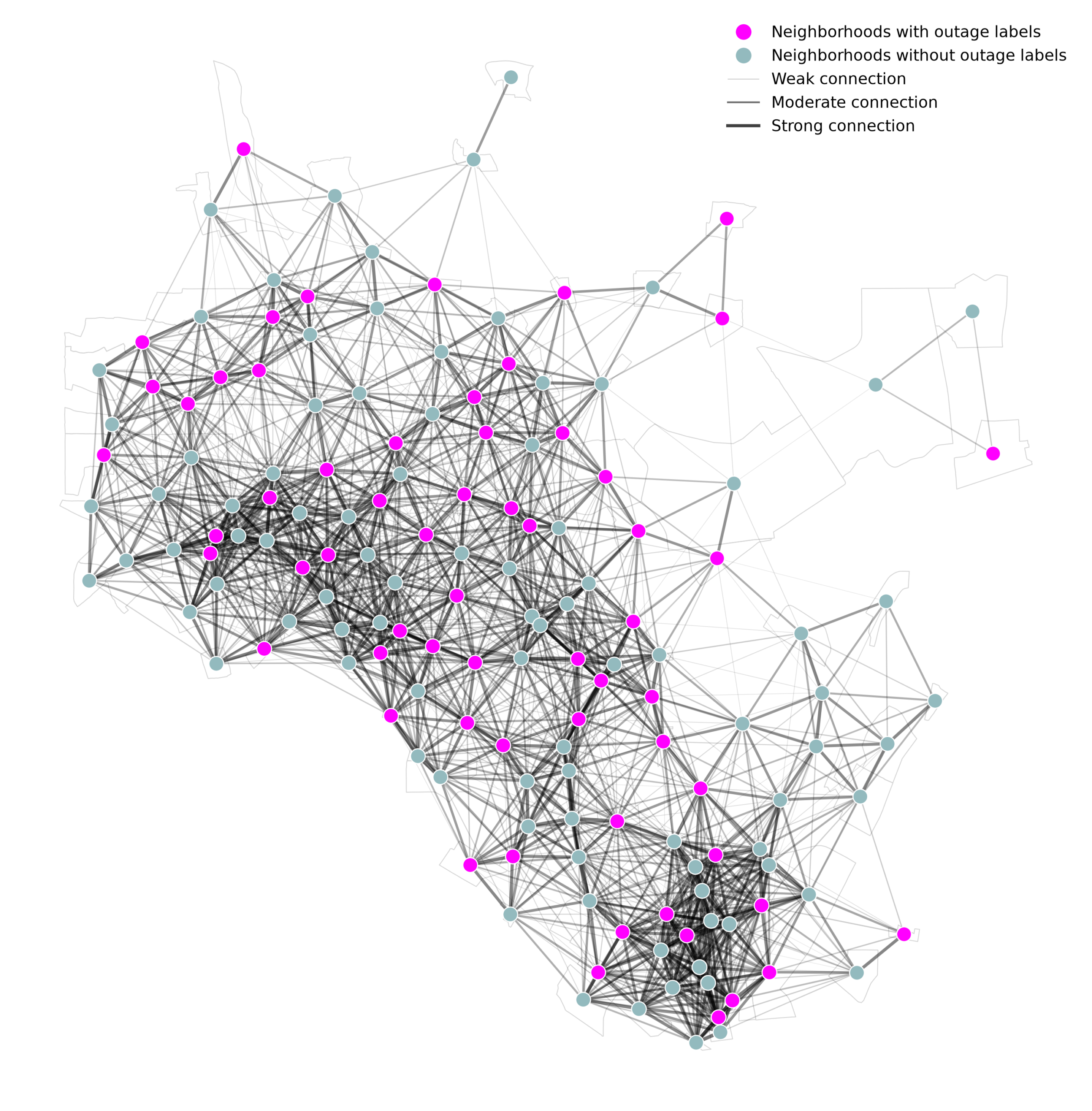
This project uses the Greater Accra Region of Ghana as a case study, combining high-resolution outage data collected at customer locations with weather observations from local weather stations. We represent neighborhoods as a network and interconnect them based on proximity. We describe the neighborhoods using their weather features, outage frequency, and geographical characteristics. A graph neural network (GNN), a type of machine learning model designed for networked data, learns from the instrumented neighborhoods to infer outages at the un-instrumented ones. By systematically varying how many neighborhoods are monitored and how much historical data the model learns from, we measure how much additional sensors or outage records improve performance, and where those gains might begin to level off. The results will help utilities and planners decide where monitoring investments deliver the most value for building climate-resilient distribution grids.