
Project Lead: Kaeli Swift, UW School of Environmental and Forest Sciences
Data Science Leads: Spencer Wood and Vaughn Iverson
The Commonwealth of the Mariana Islands (CNMI) is a small archipelago located in the Western Pacific. Like other island systems, the Marianas are home to several endemic and rare species, including the Micronesian megapode (Megapodius laperouse laperouse), a medium-sized ground bird (Fig. 1). Although megapodes historically inhabited all of the Mariana Islands, today, they are only rarely detected on the Island of Tinian. Monitoring for this species is a top priority for local state agencies and for federal agencies such as Navel Facilities Engineering Systems Command (NAVFAC), whose strong presence on Tinian is the result of ongoing US Military development. Our work primarily concerned the development of an avian acoustic monitoring system that will be used on Tinian to detect for the presence of this rare species and track changes to bird communities over time.
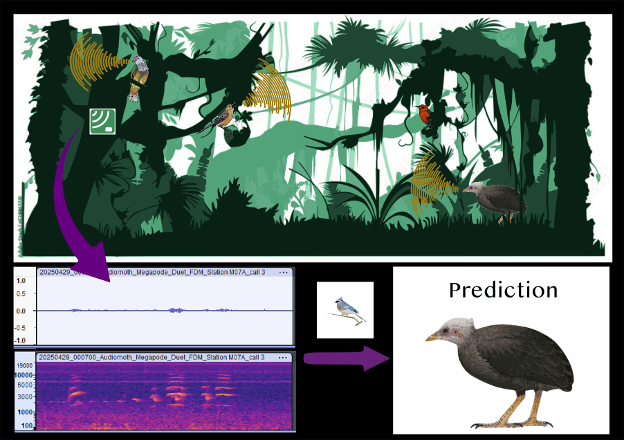
Although the popularity of acoustic monitoring has resulted in increasing availability of pre-trained classifiers, no such resources were available for any forest bird species in this region (Fig. 2). Our aim was to work with the eScience specialists to understand and produce a deep learning classifier capable of detecting acoustic recordings of megapodes to determine if and where they occur on Tinian. By building computing skills with python, container development, and deep-learning models, we were able to successfully build a custom megapode classifier, capable of processing thousands of hours of acoustic recordings (Fig 3.). This achievement will allow us to deploy acoustic recorders across the island, and then quickly process the resulting sound files for evidence of megapodes. The detection of megapodes on Tinian would represent an incredible achievement for wildlife monitoring in the region and have major implications to management for this species.